
KIA Niro: Battery capacity label (Kia Niro EV / Hybrid)
KIA Niro EV, Hybrid - Second generation - (SG2) (2021-2024) - Owner's manual / Maintenance / Battery / Battery capacity label (Kia Niro EV / Hybrid)
Battery capacity label
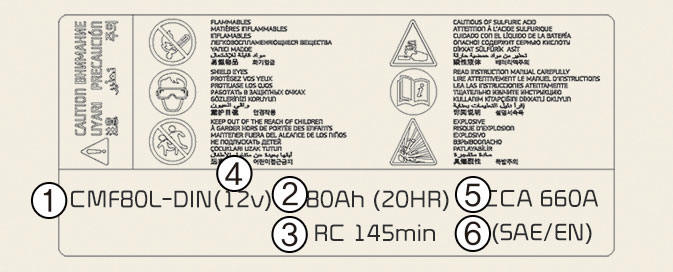
Example
* The actual battery label in the vehicle may differ from the illustration.
- The Kia model name of battery
- The nominal capacity (in Ampere hours)
- The nominal reserve capacity (in min.)
- The nominal voltage
- The cold-test current in amperes by SAE
- The cold-test current in amperes by EN
Battery recharging
Your vehicle has a maintenance-free, calcium-based battery.
- If the battery becomes discharged in a
short time (because, for example, the
headlights or interior lights were left
on while the vehicle was not in use),
run the vehicle for at least approximately
60 minutes while driving or at
idle.
Also, connect the fully automatic regulated charger to the 12V battery located in the motor room compartment.
- If the battery gradually discharges because of high electric load while the vehicle is being used, recharge it at 20~30 A for 2 hours.
WARNING
When recharging the battery, observe the following precautions:
- The battery must be removed from the vehicle and placed in an area with good ventilation.
- Watch the battery during charging, and stop or reduce the charging rate if the battery cells begin gassing (boiling) violently or if the temperature of the electrolyte of any cell exceeds 49ºC (120ºF).
- Wear eye protection when checking the battery during charging.
- Disconnect the battery charger in the following order.
- Turn off the battery charger main switch.
- Unhook the negative clamp from the negative battery terminal.
- Unhook the positive clamp from the positive battery terminal.
- Before performing maintenance or recharging the battery, turn off all accessories and stop the vehicle.
- The negative battery cable must be removed first and installed last when the battery is disconnected.
- We recommend that you use batteries for replacement from an authorized Kia dealer/service partner.
Reset items
Items should be reset after the battery has been discharged or the battery has been disconnected.
- Auto up/down window
- Sunroof
- Trip computer
- Climate control system
- Driver position memory system
- Infotainment system
READ NEXT:
 Tires and wheels
Tire care
For proper maintenance, safety, and
maximum fuel economy, you must
always maintain recommended tire
inflation pressures and stay within the
load limits and weight distribution recommended
for your vehicle.
Recommended cold tire infla
Checking tire inflation
pressure
Remove the valve cap from the tire
valve stem. Press the tire gauge firmly
onto the valve to get a pressure measurement.
If the pressure is low, add
air until you reach the recommended
amount.
If you overfill the tire, release air by
Wheel alignment and tire
balance
The wheels on your vehicle were aligned
and balanced carefully at the factory to
give you the longest tire life and best
overall performance.
If you notice your vehicle vibrating when
driving on a smooth road, your wheels
may need to be rebal
SEE MORE:
Checking the tire
pressure
Tire Pressure Monitoring System (TPMS) (if equipped)
Low tire pressure telltale /TPMS malfunction
indicator
Low tire pressure position telltale
(Shown on the LCD display)
Check tire pressure
You can check the tire pressure in the
Driver's and passenger's front air bag
Driver's front air bag / Passenger's front air bag
Driver's knee air bag (if equipped)
The indications of the system's presence
are the letters "AIR BAG" intagliated on
the air bag pad cover in the steering
wheel and the pa
Categories
- Home
- KIA Niro EV, Hybrid - Second generation - (SG2) (2021-2024) - Owner's manual
- Kia Niro - First generation - (DE) (2017-2022) - Service and Repair Manual
- Contact Us
