
KIA Niro: Purge Control Solenoid Valve (PCSV)
Kia Niro - First generation - (DE) (2017-2022) - Service and Repair Manual / Engine Control / Fuel System / Engine Control System / Purge Control Solenoid Valve (PCSV)
Specification
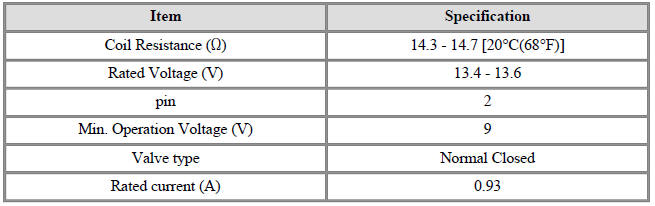
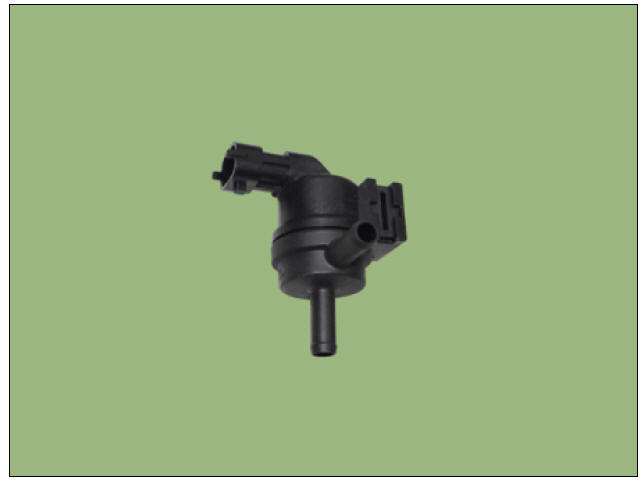
Purge Control Solenoid Valve (PCSV) Description and operation
Description
Installed on the intake manifold, the Purge Control Solenoid Valve (PCSV)
controls the evaporative
purge between the canister and the intake manifold. It is a solenoid valve and
is open when the ECM
grounds the valve control line. When the passage is open (PCSV ON), fuel vapor
stored in the canister
is transferred to the intake manifold.
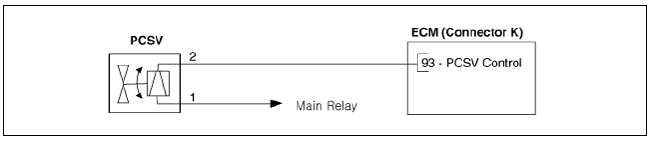
Circuit Diagram
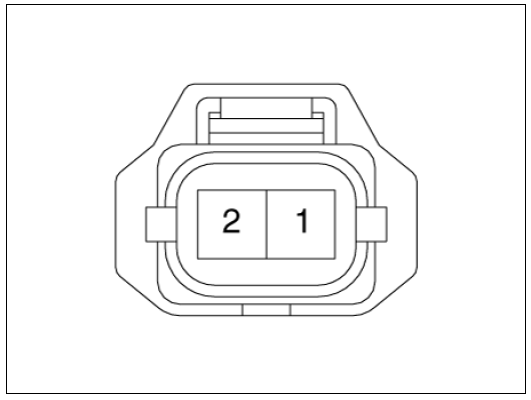
Harness Connector
Purge Control Solenoid Valve (PCSV) Repair procedures
Inspection
- Switch "OFF" the ignition.
- Disconnect the PCSV connector.
- Measure resistance between the PCSV terminals 1 and 2.
- Check that the resistance is within the specification.
Specification: 14.3 - 14.7 Ω (20ºC(68ºF))
Removal
- Switch "OFF" the ignition and disconnect the negative (-) battery terminal.
- Remove the air cleaner assembly.
(Refer to Engine Mechanical System - "Air Cleaner")
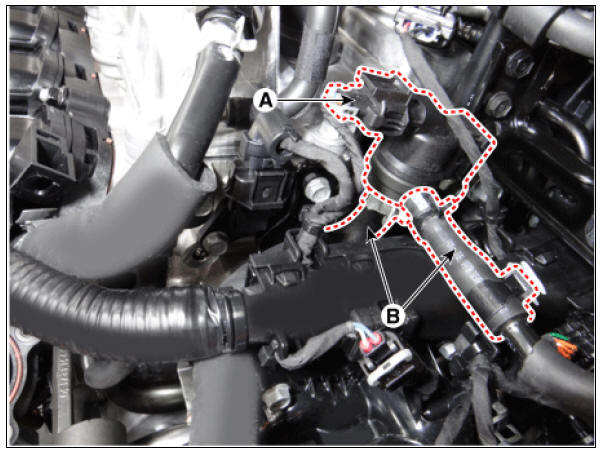
- Disconnect the purge control solenoid valve connector (A).
- Disconnect the vapor hoses (B) from the purge control solenoid valve.
- Remove the purge control solenoid valve.
Installation
Warning
- Note that internal damage may occur when the component is dropped. If the component has been dropped, inspect before installing.
- Use care to keep foreign material out of the valve.
- Install in the reverse order of removal.
READ NEXT:
 Variable Force Solenoid (VFS)
Description
Continuous Variable Valve Timing (CVVT) system advances or retards the valve
timing of the intake
and exhaust valve in accordance with the ECM control signal which is calculated
by the engine speed
and load.By controlling CVVT, the
CVVT Oil Control Valve (OCV)
Specification
Bank 1 / Exhaust
Description
Continuous Variable Valve Timing (CVVT) system advances or retards the valve
timing of the intake
and exhaust valve in accordance with the ECM control signal which is calculated
by the engine spe
Fuel Pressure Control Valve (FPCV)
Specification
Fuel Pressure Control Valve (FPCV) Description
Description
Installed on the high pressure fuel pump, the Fuel Pressure Control Valve
controls the flow of fuel into
the injectors in accordance with the ECM signal calculated ba
SEE MORE:
High Voltage Battery System / Repair Procedures
Removal
Warning
Be sure to read and follow the "General Safety Information and
Caution" before doing any work related with the high
voltage system. Failure to follow the safety instructions may result in
serious electrical inju
Parking on hills
Generally, if you have a trailer attached
to your vehicle, you should not park your
vehicle on a hill. People can be seriously
or fatally injured, and both your vehicle
and the trailer can be damaged if unexpectedly
roll down hill.
However, i
Categories
- Home
- KIA Niro EV, Hybrid - Second generation - (SG2) (2021-2024) - Owner's manual
- Kia Niro - First generation - (DE) (2017-2022) - Service and Repair Manual
- Contact Us
