
KIA Niro: Compression Pressure Inspection
Warning
If the there is lack of power, excessive oil consumption or poor fuel economy, measure the compression pressure.
- Warm up and stop the engine.
Allow the engine to warm up to normal operating temperature.
- Remove the air cleaner.
(Refer to Intake and Exhaust System - "Air Cleaner")
- Remove spark plugs.
(Refer to Engine Electrical System - "Spark Plug")
- Check cylinder compression pressure.
(1) Insert a compression gauge into the spark plug hole. If possible, place the gauge where it can be seen from inside the vehicle.
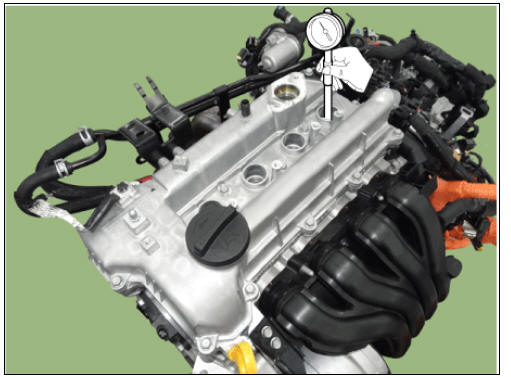
(2) Attach the KDS.
- Connect the cable of KDS to the data link connector.
- Select the vehicle model and then the HCU system.
- Select the "Engine Test On". See the screens below.
(3) While cranking the engine, measure the compression pressure.
- With the Brake pedal depressed, press the Start/Stop Button (SSB) one time.
- If the engine cranks, let it crank about 8 to 10 cycles (until the gauge readings stabilizes) then press the SSB one time to stop the engine from cranking.
- If the engine does not crank on its own when the SSB is pressed, the KDS should be used to crank the engine. While in the "Engine Test On" follow the instruction on the screen.
- The "Engine Test On" will start the engine cranking. After the compression readings stabilize (8-10 cycles), press the SSB one time to stop the cranking.
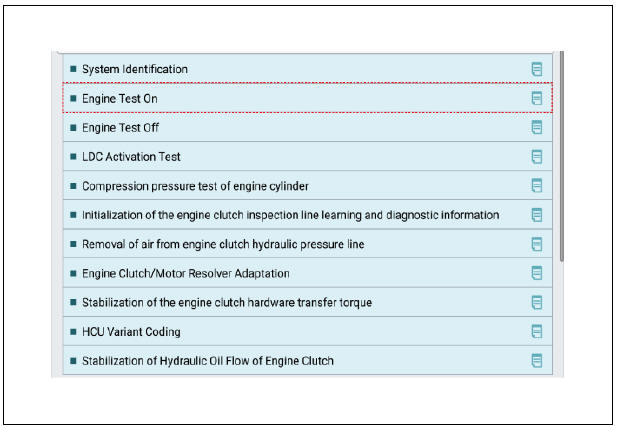
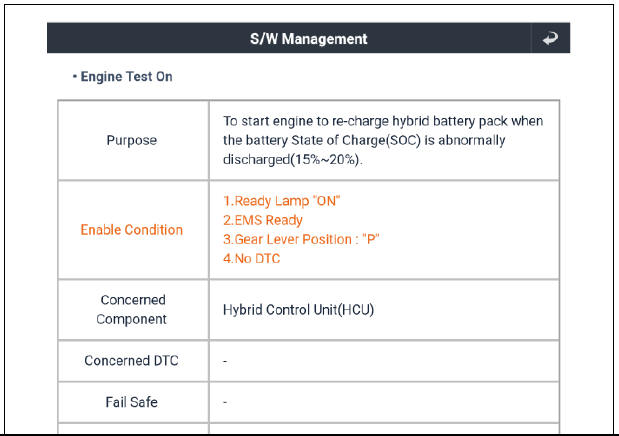
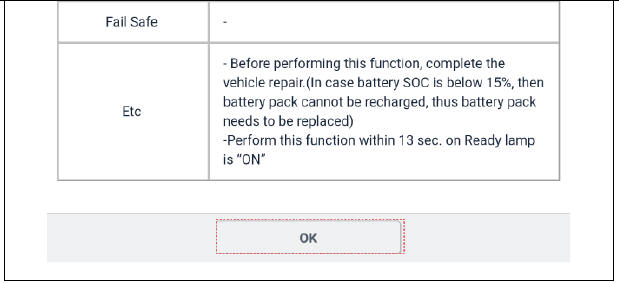
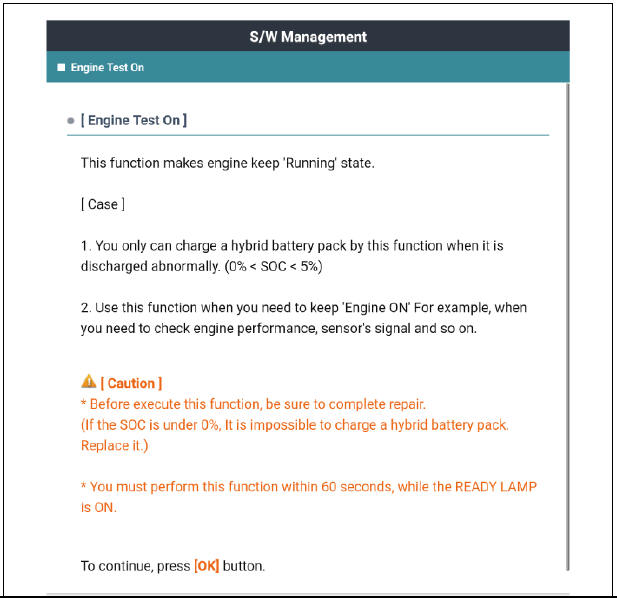

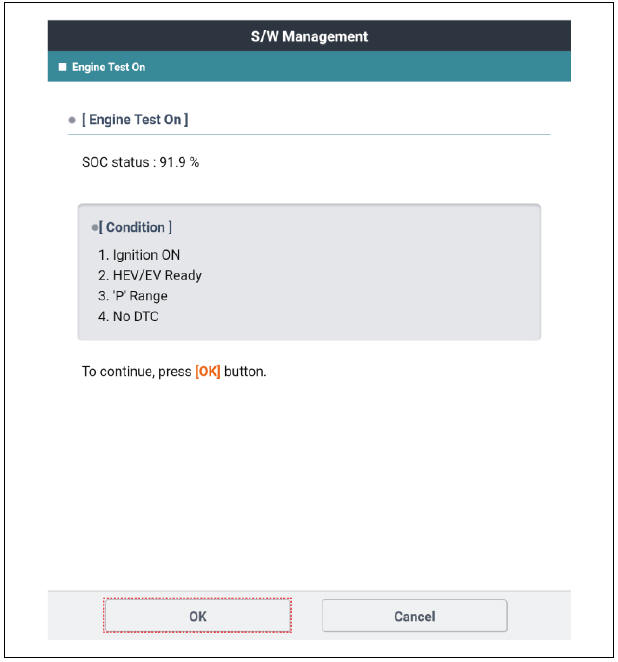
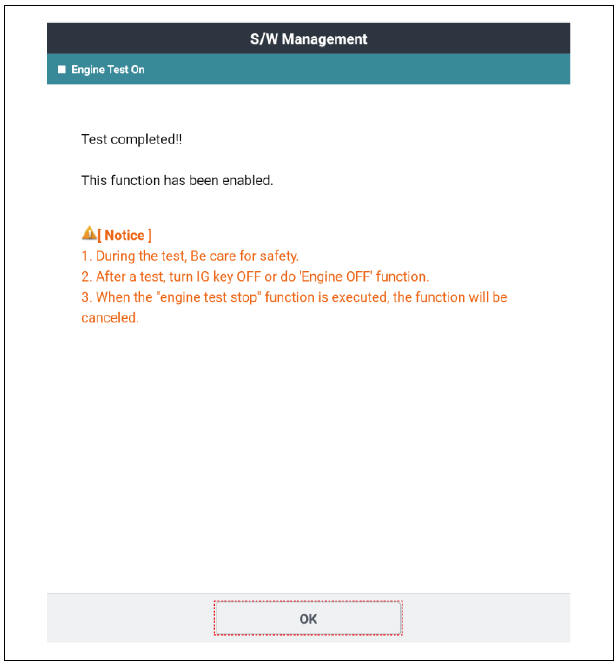
(4) Repeat steps (1) through (3) for each cylinder.
Warning
Be sure ignition is in the OFF mode between each cylinder test.
This measurement must be done while the engine is still near operating temperature.
Compression pressure :
981kPa (10.0kgf/cm², 142psi) / 300 - 350rpm
Minimum pressure :
834kPa (8.5kgf/cm², 121psi) / 300 - 350rpm
Difference between each cylinder :
100kPa (1.0kgf/cm², 15psi) or less
(5) If the cylinder compression in 1 or more cylinders is low, pour a small amount of engine oil into the cylinder through the spark plug hole and repeat steps (1) through (3) for cylinders with low compression.
- If adding oil helps the compression, it is likely that the piston rings and/or cylinder bore are worn or damaged.
- If pressure stays low, a valve may be sticking or seating is improper, or there may be leakage past the gasket.
- Reinstall spark plugs.
Tightening torque : 14.7 - 24.5 N*m (1.5 - 2.5 kgf*m, 10.8 - 18.1 lb*ft)
- Install ignition coils.
Tightening torque : 9.8 - 11.8 N*m (1.0 - 1.2 kgf*m, 7.2 - 8.7 lb*ft)
- Connect the injector connectors and ignition coil connectors.
- Some DTC's may exist after the inspection test and may need to be manually cleared with KDS.
READ NEXT:
 Engine Mechanical System / Troubleshooting
Symptoms :
Engine misfire with abnormal internal lower engine noises
Suspected area → Remedy
Worn crankshaft bearings → Replace the crankshaft and bearings as re
Cooling System
Components
Reservoir tank
Reservoir hose & pipe
Radiator
Radiator upper hose
Radiator lower hose
Radiator upper mounting bracket (RH)
Radiator upper mounting bracket (LH)
Radiator lower mounting insulator (RH)
Radiator low
Coolant Repair procedures
Warning
Never remove the radiator cap when the engine is hot. Serious
scalding could be caused by hot fluid under
high pressure escaping from the radiator.
Warning
When pouring engine coolant, shut the relay box lid and be careful
not to spil
SEE MORE:
AUTO (Automatic) mode (Plug-in hybrid vehicle)
A: Automatic mode
The drive mode will be automatically
selected from either Electric (CD) mode
or Hybrid (CS) mode by the system
according to the driving condition.
CS (Charge Sustaining, Hybrid) mode (Plug-in
hybrid vehicle)
A: Hybri
Power Door Mirrors
Power Door Mirrors / Components And Components Location
Power door mirror
Power door mirror switch
Power folding mirror switch
Connector and Terminal Function
Driver Power Window Switch (Non-IMS Type)
Driver Power Window Swit
Categories
- Home
- KIA Niro EV, Hybrid - Second generation - (SG2) (2021-2024) - Owner's manual
- Kia Niro - First generation - (DE) (2017-2022) - Service and Repair Manual
- Contact Us
